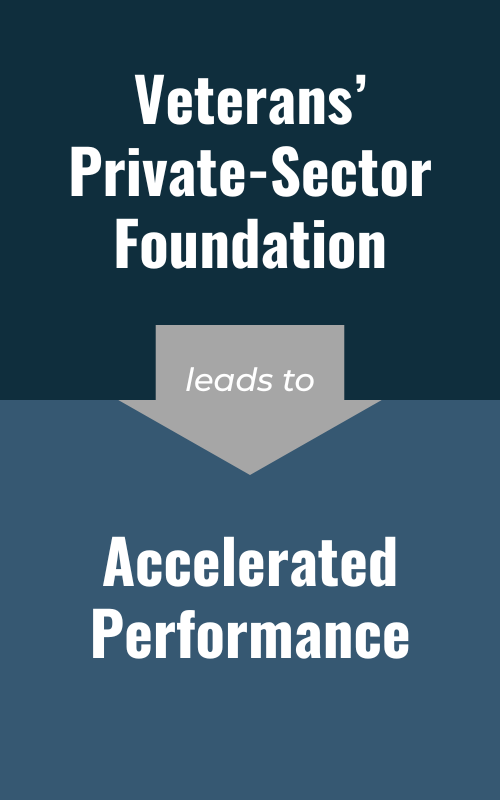
We train veterans first—then their managers—so performance shows up sooner.
The Hidden Workforce Problem
Most employers assume veterans arrive ready to thrive in civilian roles. The reality is more complex.
Veterans want to perform—but the private sector runs on mental models fundamentally different from the military. Without grounding in how business actually works, even strong veterans can operate with an incomplete picture of what “good performance” looks like.
Employers Often Misread This As:
● Uncertainty about how their work connects to business goals
● Hesitation about which questions to ask—and when
● Limited understanding of informal networks and workflows
● Difficulty prioritizing what matters most to the business
These are not motivational issues. They are structural mismatches the veteran was never trained to recognize.
Why This Problem Exists
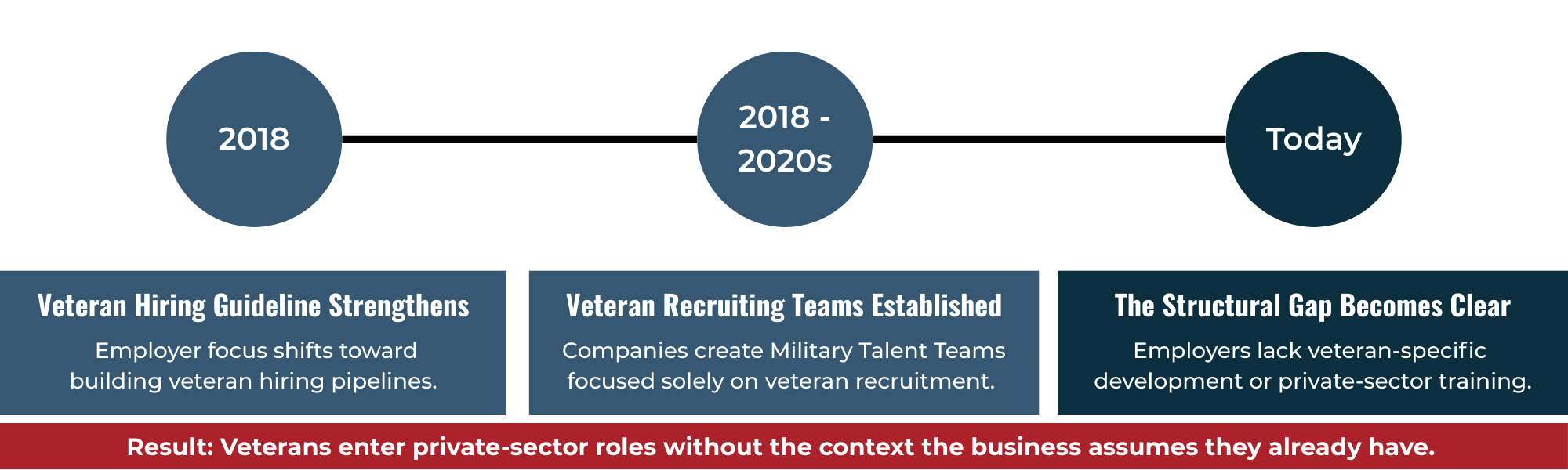
Back in 2018, national HR guidance encouraged employers to build veteran hiring pipelines—not development pipelines.
As a result, many organizations created Military Talent Teams focused almost entirely on recruitment.
These teams were often staffed by former military recruiters, tasked with hitting hiring goals, and expected veterans to “plug in” once onboard.
But ownership of veteran performance and development was rarely assigned—and training to prepare veterans for civilian business environments was largely absent.
Companies unintentionally built systems where veterans were hired enthusiastically—but entered the workforce without the context needed to operate confidently inside it.
That missing context is the actual performance barrier PreVeteran solves.
The PreVeteran Solution: Veteran First → Manager Second
Most organizations focus on training managers first. PreVeteran starts where performance actually begins.
We build private-sector readiness at the source—then align managers to amplify it.
Veterans learn the fundamentals the private sector assumes every new hire already knows:
● How companies are structured
● How decisions are made
● How value is created
● How their role supports the business
Once that foundation is in place, managers can better learn how to:
● Reinforce early progress
● Clarify expectations
● Eliminate accidental friction
● Accelerate productivity without micromanaging
This two-part system shortens ramp time and brings out the value you hired the veteran for.
What We Teach Veterans (First)
Veterans aren’t underperforming—they’re operating without the context civilian workplaces assume.
PreVeteran teaches veterans the fundamentals the private sector assumes they already know:
Understand the business: Who does what, how work moves, and how functions connect.
Navigate the system: Formal authority vs. informal influence, shifting priorities, and when to take initiative.
See how value is created: What drives revenue, what drives cost, and how their role supports both.
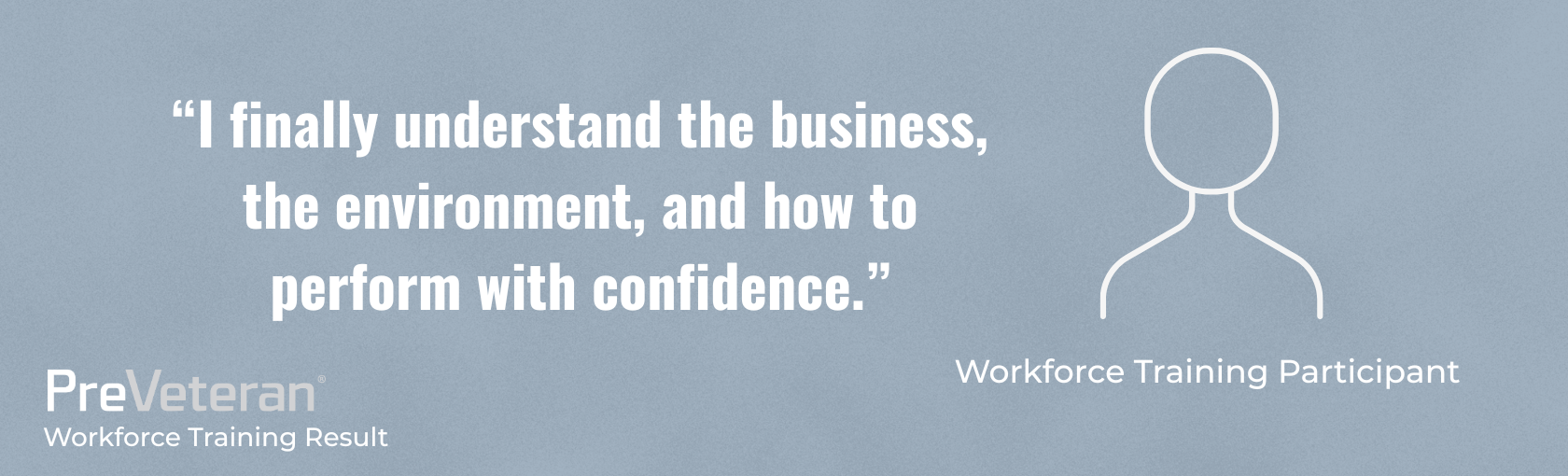
With this foundation, veterans gain confidence, clarity, and control inside an environment that once felt unfamiliar.
With veterans grounded in private-sector fundamentals, managers can finally support them effectively…
What We Teach Managers (Second)
Once veterans understand how the business works, managers can reinforce progress instead of compensating for gaps.
PreVeteran teaches managers how to:
Reinforce progress: Connect daily work to business goals and validate early wins.
Clarify expectations: Translate priorities, define success, and remove ambiguity.
Eliminate friction: Spot misalignments early and address them before they slow performance.
With aligned managers, veterans ramp faster, contribute sooner, and stay longer—because both sides finally understand the same system.
Free Download: Workforce Development Brief
A 5-page guide that shows how to fix early-career veteran struggles at their root—and get better performance sooner. Created by PreVeteran, a workforce innovation partner on a National Science Foundation–funded initiative.
Most veterans are hired for their skills and experience—but are never taught how civilian organizations actually operate.
This training fills the missing context veterans are expected to already understand: how decisions are made, how work moves, how value is created, and how performance is evaluated. Without that foundation, even strong veterans can struggle early—not because of motivation, but because the system is unfamiliar.
Isn’t this what onboarding is for?
Traditional onboarding focuses on company policies, tools, and role-specific tasks. It rarely teaches how the business itself works.
PreVeteran complements onboarding by giving veterans a reusable, transferable understanding of how civilian organizations function—so onboarding becomes more effective instead of overwhelming.
Why not just train managers?
Manager training helps—but it can’t fix a knowledge gap the veteran doesn’t know exists.
If a veteran doesn’t understand how the business operates, managers end up compensating, translating, or micromanaging. PreVeteran flips the model: veterans build foundational understanding first, then managers learn how to reinforce and accelerate performance—without added friction.
How quickly will we see improvements?
Many veterans experience immediate clarity once they understand how the business actually works — what success looks like, how decisions are made, and how their role creates value.
While this training can benefit veterans at multiple stages, organizations see the strongest and fastest impact when it’s delivered within the first 0–24 months of hire before assumptions harden and workarounds become normalized — though the training remains valuable at later stages as well.
This early clarity allows managers to reinforce progress instead of compensating for gaps — accelerating contribution across the system.
Does this replace mentorship or ERGs?
No. It makes them more effective.
Mentorship and ERGs provide support and community. PreVeteran provides operational clarity. When veterans understand the system they’re operating in, mentorship conversations become more productive and ERG efforts shift from problem-solving to growth.
How does this fit with our L&D programs?
PreVeteran integrates cleanly into existing learning and development ecosystems.
It’s not role-specific or company-specific—it’s foundational. That makes it easy to layer alongside onboarding, leadership development, or technical training, without competing for attention or time.